Welcome to everyone reading this blog. Hope you all are doing fine. So we are going to talk about a very common topic “hernia”.
Before we go into any details, let me tell you hernia has many types and for now we are only going to talk about the most common ones including inguinal, umbilical, para umbilical, abdominal mid line, femoral and incisional hernia and the difference in approach to hernia in adult and pediatric age group. We will try to avoid medical terms as much as possible and try to explain things in common terms
So how does a hernia present? Hernia sign and symptoms and its types
It usually presents as a lump on body mostly in inguinal region( groin) , in or around umbilicus, on your abdominal wall ( front and sometimes on the back) , on the site of previous surgical scar or in the upper part of thigh, that increases or decreases in size, sometimes completely vanishing and sometimes becoming huge in size, occasionally it can be painful as well but usually painless although uncomfortable
We name them according to their location as follow
Inguinal hernia ( in inguinal region or groin, starting from lower part of abdominal wall and can go upto scrotum/ labia
Umbilical and para umbilical hernia( in umbilical region or around umbilicus)
Incisional hernia ( in previous surgical scar)
Femoral ( in upper part of thigh)
Once again let me remind you we are only talking about the most common type of hernias
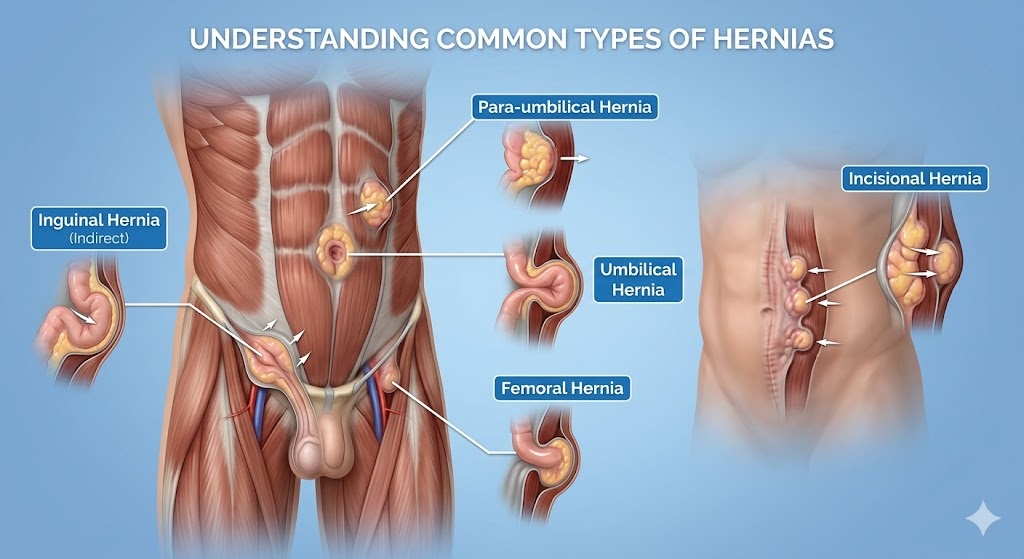
Now that we know how hernia presents and what can be it’s common types, let’s see what hernia really is
Think about it that your abdomen (tummy/belly or whatever you want to call it) is like a cavity and your gut( intestine) and omentum ( fat) are its content. The cavity of abdomen has two walls, the front one (anterior wall) and the back one (posterior wall). Now for some reason these walls develop a defect somewhere in them and contents of the cavity that is intestine and omentum start moving (herniating) in and out of this defect. Remember that this defect is still covered by skin and fat and the defect lies in fascia or muscle. Whenever the pressure inside the abdomen increases the contents herniate through this defect and form a lump that is covered by skin.
So now that we have a fair idea what a hernia is, let’s get to the real deal.What to do if someone develops a hernia? Can it be dangerous? How to treat it? Should it be treated immediately?Does it require a surgery or can it be treated medically? Do we even need to treat a hernia? What will happen if we do not treat a hernia?Why is it that the hernia sometimes increases in size and then decreases in size and sometimes disappears? What factors make a hernia grow big in size or small in size, and what effect does it have on your body?
So let’s answer these questions one by one. So the thing is that a hernia should always be repaired surgically. There is no medical treatment for hernia, although there are few measures which can help you reduce the discomfort associated with hernia, but the hernia will never heal or repair by itself. If someone develops a hernia, he or she does not need to go for the surgery immediately unless he or she develops danger signs, which means that the hernia is either irreducible, obstructed, or strangulated. We will talk about the danger signs later. Any factor that increases the pressure inside your abdomen will lead to the increase in size of hernia, or sometimes a hernia that is not obvious will become obvious. Running, crying, laughing, exerting, and physical activity increase the intra-abdominal pressure and hence lead to the increase in the size of hernia. On the other hand, lying down and resting brings the intra-abdominal pressure to normal or decreases the intra-abdominal pressure relatively, so it leads to the reduction in the size of hernia or its disappearance completely.
People who have a hernia will know very well that a hernia can be easily reduced by applying gentle pressure with their hand or sometimes finger, which leads to the reduction of the contents into the abdominal cavity. People who have hernia over a long period of time are very well experienced at reducing their hernia by themselves.
So what can you do if you do not immediately want to go for surgical repair? Well, you can apply abdominal belts and scrotal support to keep the contents of the hernia reduced. An abdominal belt or sacral support will help reduce the discomfort associated with the hernia and some even say that it does not let the size of the hernial defect increase but by no means will it lead to the repair or healing of the hernial defect.
So some of you might still be wondering why we should surgically repair a hernia or treat a hernia. Well, hernia is a highly uncomfortable condition. Just imagine your intestine herniating out of your abdomen into the hernial sac. Sometimes the hernias can grow massively in size, leading to a large proportion of your intestine herniating from your abdomen into the hernial sac.
With the time, the hernial defect will only increase in size, which will lead to the increase in the size of the hernia.Making the condition even more uncomfortable, people with a hernia also often complain of constipation, indigestion or dyspepsia, or associated gastrointestinal symptoms.
Now let’s talk about the real complication of a hernia. Think about it this way. The contents of the abdomen are coming through a defect in the abdominal wall into the hernial sac. The contents slide one by one into the hernial sac from the abdominal cavity, but there comes a time when all of these contents cannot go back into the abdominal cavity, and hence we say that the hernia is now irreducible. In other terms, the contents of a hernial sac that are the intestine or the omentum are now trapped into the hernial sac.Keep in mind that every time you feel that the contents of a hernia are not going back into the abdominal cavity, it is not that the hernia is irreducible.They might reduce once you lay down, relax, and the muscles of your abdominal wall relax, or they can also be reduced by gentle manipulation or maneuver by a doctor, or people who have a hernia for a long period of time actually know how they can reduce the contents of a hernial sac.
So when do you really need to worry or consult your doctor? Or what are the actual danger signs in a hernia? Well, irreducibility of a hernia is one of them, but you have to be sure that the hernia is actually irreducible. To make things easy, if you are lying down, relax, and even after gentle manipulation or pushing the contents of the hernia back into the cavity, does not reduce the hernia, this is a danger sign and you should consult your doctor. By this time, your hernia is irreducible and can be painful and this is a dangerous sign. This can lead to the obstruction, which is intestinal obstruction and will produce symptoms like abdominal distension, vomiting that can be yellow or green in colour (bilious), constipation and pain at the site of hernia and abdomen. The contents of the intestine are actually the fecal matter or the undigested food. So if the contents of a hernia cannot be reduced, this will lead to intestinal obstruction and it can lead to very severe, grave consequences. By this time, the hernia is obstructed and immediate surgical intervention is required, because if immediate surgical intervention will not be done, this will lead to strangulation of the bowel. Strangulation of bowel means that now the blood supply of the intestine is being compromised and this will lead to the gangrene of the gut. Gangrene means death of the cells of the gut or simply your intestine is now dying which will eventually lead to death
Now make it simple a hernia can lead to
•irreducible hernia, which can lead to
•obstructed hernia which can lead to
•strangulated hernia which can lead to
•gangrenous gut.
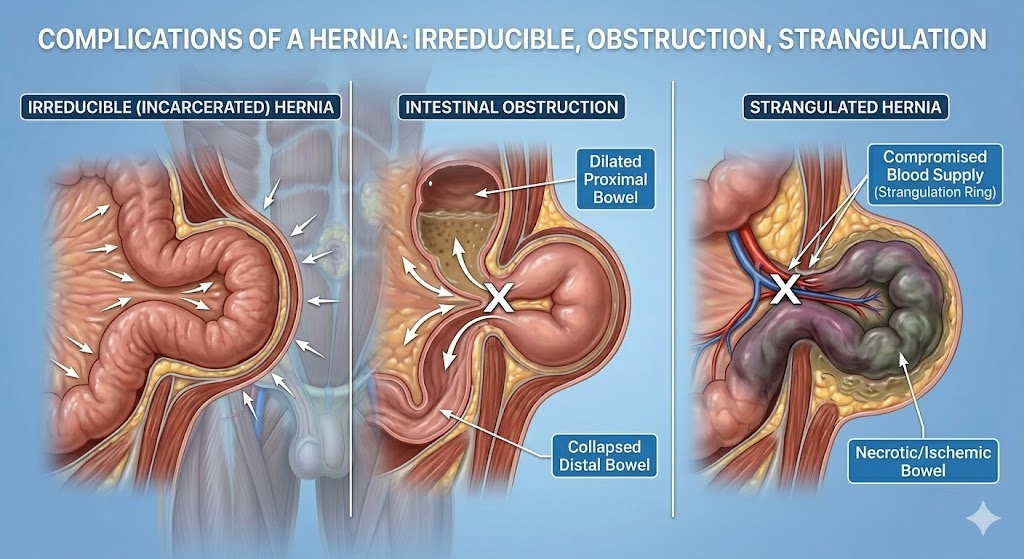
Emergency intervention should be done at the point where hernia is irreducible to avoid further damage. The more the delay in intervention the severe the condition gets.
Remember never wait for a hernia to develop complication, get it operated when its uncomplicated.
Danger signs and symptoms are as follow
- an irreducible hernia which will lead
- pain at the site of hernia and abdomen,
- abdominal distension
•vomiting that can yellow or green (bilious) in colour - inability to pass stool ( constipation)
- changes in skin overlying hernia ( redness, shiny skin)
Treatment for hernia is always surgical. If a hernia is reducible, it’s not an emergency and the surgical options are by open surgical method and by laparoscopic method.
Open method in adults involves herniotomy and mesh placement(hernioplasty). It leaves you with a scar at the site of surgery
Laproscopic ( surgery with the help of camera) options
Include TEPP and TAPP
And have the benefit of no significant scar and early mobilisation.
Whether the surgery is done by open method or laproscopicaly depends on the expertise of the surgeon and the facilities available.
Widely all over the world the surgery is done by open method but developed countries the laproscopic approach is becoming more popular
For an irreducible, obstructed, strangulated hernia surgery is almost always done by open method and mesh is not used.
We are not discussing hernia in paediatric age group because the blog is getting a bit long. We also wanted to discuss the merits and demerits of open and laproscopic surgery and possible complications of surgery but let’s just leave that for another blog
Very knowledgeable information about Hernia for students specially who related to medical field
thanks
👍👍👍
،👍👍👍
Very informative
👍
Thanks doc for this informative blog👍👍
It is a very good website, it has a lot of knowledge and is useful.
It is a very good website, it has a lot of knowledge and is useful.
It assists a lot to understand some complex medical issues
very informative
Information on Diseases / problems are very elaborative from medical perspective.